
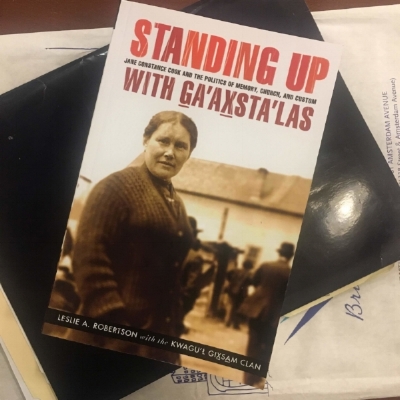
In this post, current OHMA student Yutong Wang (2016) discusses her perspectives on being a historian and how politics influence historical revisionism. This article is the second in a two-part series exploring Dr. Leslie Robertson’s recent OHMA Workshop Series lecture, “Devalued Subjectivities: Disciplines, Voices and Publics.”
Read MoreCreating Dynamic Dialogue with Our Past and Present: Reflections on ‘Below the Grid’ (Part II)
In this post, current OHMA student Xiaoyan Li (2016) reflects on how the dynamic dialogic process enlightens the shadows of our past and present.
This article is the second in a three-part series exploring Jack Kuo Wei Tchen’s recent OHMA Workshop Series lecture, “Below the Grid.”
Read MoreThe Dialogic Space & Feeling the Human Story: Reflections on 'Below the Grid' (Part I)

Image courtesy of pixabay.com
In this post, Chinonye Alma Otuonye explores the dialogic space as a mechanism towards a human understanding of the self and history. She reflects on the ways John Kuo Wei Tchen—NYU professor, historian, and curator—decolonizes both space and history within and through his work.
This article is the first in a three-part series exploring Tchen’s recent OHMA Workshop Series lecture, “Below the Grid.”
Read MoreOHA 2016: Generations in Conversation

In Context Journal asks 2016 Oral History Association Annual Meeting attendees what they would like to see in future issues.
In this post, OHMA alumna Cindy Choung (2009), recipient of our first OHMA Alumni Conference Travel Grant, writes on dialogue and difference among oral history practitioners at the 2016 Oral History Association Meeting. She offers thoughts on creating space for connection and reflection between oral historians across generations.
Read MoreOral History as Excavation: Exploring ‘Voices of Crown Heights’ (Part I)

Source: 6sqft.com
This article is the first in a three-part series examining the Brooklyn Historical Society’s ongoing oral history project “Voices of Crown Heights.” In this post, current OHMA student Dina Asfaha (2016) writes that Zaheer Ali's project is a prime example of the need for oral history in understanding society. She proposes that Ali does an exemplary job of situating people's narratives in their respective historical contexts and putting those narratives in conversation with one another in order to deduce conclusions about how gentrification in Crown Heights can be understood today.
Read More
Quisque iaculis facilisis lacinia. Mauris euismod pellentesque tellus sit amet mollis.