
Explore the work of students and alumni who have been using their work to amplify Black voices, end mass incarceration, and challenge white supremacy.
Read MoreListening in Space

NPR host Diane Rehm and her son David conduct an interview in the StoryCorps MobileBooth. The space is lined in wood paneling and has low lighting focused on the table where the speakers sit. Two microphones are in the center of the table pointed at Diane and David who sit across from each other in padded booths. Diane has white shoulder-length hair, is wearing a beige cardigan and is smiling at David. David is bald with a short white beard, glasses, and is in a dark suit. Both have light skin. Photo by Shawn Miller from the Library of Congress.
There are many factors at play during an interview, affecting both the questions being asked and the stories being told. In this blog post, current OHMA student Lauren Instenes analyses the impact of one of the less talked about factors, space.
Read MoreJourneys Through Spaces: Spoken, Written, Physical and Virtual
In this blogpost, inspired by Carlin Zia’s March 5th OHMA presentation on her book “Uncertain Journeys,” Lisa R. Cohen reflects on the fluid nature of shared memories in different spaces - traveling back and forth between spoken, written, physical and even, increasingly, the virtual world.
Read MoreHug Your Plant! and Other Self-Care Tips for Oral Historians in Lockdown
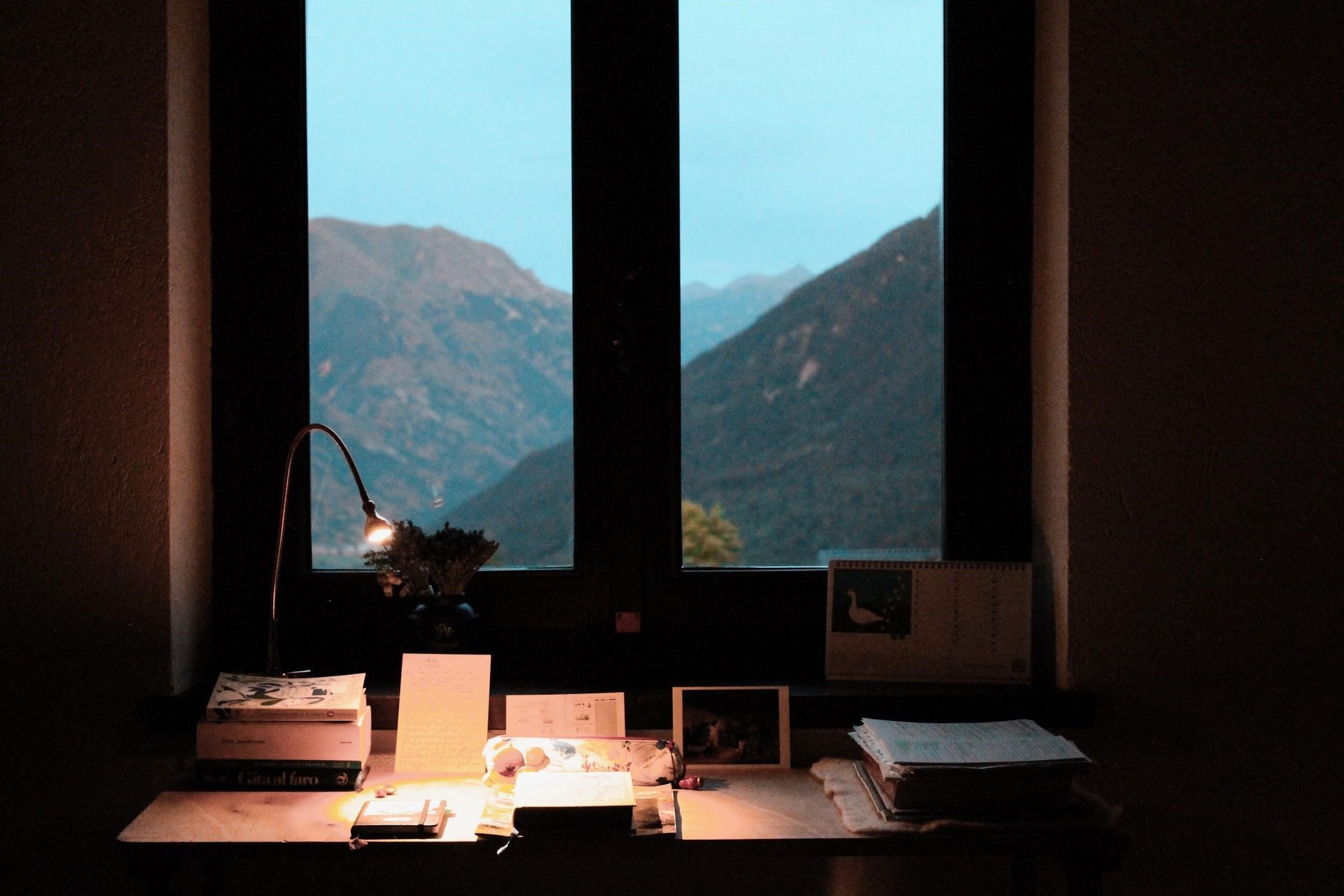
A desk in front of a window. It’s sunset. The window looks out onto mountains. On the desk there are books, notebooks, postcards and a pencil case.
Photo Credit: Eleonora Anedda
Ted Kerr’s wise words inspired OHMA student Eleonora Anedda to reflect on the responsibilities of oral historians in times of crisis. Not so much on their duty towards others, but their obligations towards themselves. This piece will examine much needed self care habits that can be incorporated in our lockdown routines.
Read MoreUncovering Thyself: Identity Politics & Oral History

Illustration of a ghost (the oral historian) holding a microphone next to a person sitting down.
In this blog post, current OHMA student Marina Labarthe del Solar shares a conversation with Theodore Kerr about the importance of being transparent about your identity and positionality with the communities you work with. Marina writes about identity politics and how knowing where you stand with respect to power is an essential skill for oral historians.
Read MoreDialogue with Institutionalized Residents: Examples and Advice

Mt. Fuji in distance
(Photo: Sach Takayasu)
How do you engage in a dialogue with a narrator who lives permanently in an institution? Let me tell you a story.
Read MoreAI: An opportunity to reimagine an old-world anew

A black earbud case sits on a smartphone.
Photo by SCREEN POST on Unsplash
In this piece, Francine D. Spang-Willis reimagines a relationship with oral history and technology to create artificial intelligence that is more representative of and responsive to maintaining and perpetuating Indigenous language, knowledge, and culture. The piece is inspired by Stephanie Dinkins' Oral History as Told by AI presentation given on April 2, 2020.
Read MoreWhat can journalists learn from Oral History when covering the Covid-19 pandemic?

A an old-fashioned camera lies on top of a stack of books and papers, with a typewriter in the background. (Credit: Wallace Chuck)
To capture the complexity of the coronavirus pandemic, and to honour the voices of the communities most impacted, journalists can draw upon some of the techniques practiced by oral history.
Read MoreIn Search of Shared Experience

Two young men, wearing bright orange coveralls and rubber boots, pause near each other while laboring in a lush field, lined by tropical vegetation.
How can we invite people to dig into their memories and offer us their stories? In this blog post, Amanda Blewitt, a doctoral student in International Education, reflects on how sharing experiences with participants can evoke the past while connecting us in the present. This reflection was inspired by Laura Mitchison’s conversation with OHMA on April 9, 2020.
Read MoreWho Are You?: Thoughts on Identity and Language

The photo has a simple grey background. There is a black and white string threaded between the top corners. A small back clothespin is clipped on the middle of the string; hanging from the clothespin is a white piece of paper. Printed on the paper are the words: “I am…”
Image from: https://circlein.com/how-to-rediscover-your-identity/
How do you describe who you are? What words do you choose? What meanings do your choices carry with them? Current OHMA student Lily Doron ponders these questions in this essay on identity, language, and how we see ourselves. It is inspired by Carlin Zia’s OHMA workshop presentation, Uncertain Journeys.
Read MoreReview: “Food: From Source to Salespoint” a British Library Oral History Collection

Three dishes of hand-made pasta. The plate on the right is a simple spaghetti al sugo, the one on the bottom is a creamy pappardelle ai funghi porcini, and lastly the one on top is a spaghetti alla bottarga. This meal was enjoyed in the Fall of 2019 in Los Angeles at Pasta Sisters.
Photo Credits: Annie Yan
In this post, OHMA student Eleonora Anedda (2019 -2020 cohort) will give you a taste of the vast British Library Archive by exploring their oral history collection on food, the British kitchen scene, and its radical changes over the course of the last century. She wishes to apologiseapologizees in advance if this post makes you hungry.
Read MoreCommunity Story-Catching in Post-Conflict El Salvador

Photograph of a workshop which shows Molly Todd and Barbara Mergen talking with a group of attendees who all look to be Salvadoran. The attendees are seated in chairs in the middle of a classroom looking at large printed photographs with Barbara and Molly standing behind and leaning in to discuss the exercise.
What would it look like if we valued group narratives over individual ones? In this post Jacey Anderson (graduate student of History at Montana State University) describes the methods of collaborative, multi-generational workshops she co-facilitated in El Salvador in January 2019. Using their long-standing relationships with the community of Arcatao, Dr. Molly Todd (professor of history at Montana State University), Barbara Mergen Alvarado (bilingual and multicultural educator), and Jacey explore how to use the lessons they learned from the people of Arcatao to design highly participatory historic memory workshops.
Read MoreReport-back: China International Oral History Week
What are oral historians in China up to? OHMA Director Amy Starecheski shares her impressions from a recent trip to Beijing.
Read More“There’s no sound and it’s ok” - the unforeseen challenges of an “Oracle Circle” facilitation
Dr. Alexis Pauline Gumbs listens for a living: the mission of her work is to “create infinite ways to facilitate listening.” The renowned black feminist scholar and poet shared with us how she approaches listening to herself/body/spirit, to artistic inspiration and to others during her November 7th “"Necessary as Water": Queer Black Ceremony and the Depth of Listening” workshop. She also facilitated a listening “Oracle Circle” for audience members. Gallant Zhuangli, a Barnard College senior and oral history enthusiast, was inspired to lead an “Oracle Circle” of her own in an effort to better understand and reflect on Dr. Gumbs’ innovative listening practices.
Read More“Creating a Dark Space”: Listening to and Prioritizing Intuition

A screenshot from the 2001 Harry Potter and the Sorcerer’s Stone movie scene in which Hermione says getting expelled would be worse than getting killed. Harry, a kid with black hair and round glasses, and Ron, a red-head, are looking off-camera as Hermione storms away. Ron’s words are captioned: “She needs to sort out her priorities.” Photo credit: Warner Bros.
What do a 4 am wake-up time, the base of a pyramid, and the origin of a mathematical graph have in common? In Liu Chen’s post on the workshop led by Dr. Alexis Pauline Gumbs, they reflect on priorities in oral history practices, intuition, and the value of darkness.
Read MoreAnnouncing the 2019 Jeffrey H. Brodsky Oral History Award Winner and Runners Up!
In November of 2015, Jeffrey H. Brodsky, OHMA alum, announced a generous cash prize of $3000 for an outstanding capstone/thesis. The criteria for receiving the award is that the capstone/thesis must “make an important contribution to knowledge and exemplify the rigor, creativity and ethical integrity we teach our students.” For his own thesis Jeffrey conducted over 60 hours of videotaped interviews with politicians on their memories of their first campaigns. He created a video documentary based on his interviews, one of the first multimedia theses in our program, and was advised by OHMA co-founder Peter Bearman.
This year, our fourth awarding this prize, we had an exciting and varied pool of theses and capstones to consider. We are proud to announce the winner, Carlin Liu Zia, and three runners up, Kim-Hee Wong, Tomoko Hiramoto and Lynn Lewis. All three of these works have made unique and innovative contributions to oral history theory and practice. We are excited to share them with the world and honor the hard and important work of these emergent oral historians.
Winner

Uncertain Journeys. By Carlin Liu Zia.
Thesis Advisor: Mary Marshall Clark
Careful about every phrase, every pronoun, every silence and hesitation, Carlin Zia demonstrates how closely the acts of speaking and writing and visual memory intersect as she transcribes the story of her grandfather’s migration from China to the United States as told to her over two years. As Luisa Passerini has written, oral history is more than direct memory; it is in its deepest sense cultural memory: where poetry, visuality and narrative meet. In Uncertain Journeys, a title with great meaning for our world, Carlin invites us to join her in the journey from the past to the future by also writing about her own life. She is inspired by the oral history conversation with her grandfather and the literal journey she takes back to Changzhou, his home city in China, to encounter the palimpsests of memory that words alone cannot evoke. The journey, in the words of Luisa Passerini, is one from memory to utopia.
As Carlin writes the story of her journey, with questions that arise from the translation of her grandfather’s journey, she invokes the words of Italo Calvino, the Italian folklorist and author. I will reinvoke Calvino’s words here (because they belong with my own visual memory of Carlin carrying his well-worn book Invisible Cities into my office so many times).
The city, however, does not tell its past, but contains it like the lines of a hand, written in the corners of the streets, the gratings of the windows, the banisters of the steps, the antennae of the lightning rods, the poles or the flags, every segment marked in turn with scratches, indentations, scrolls.
And Carlin, in visiting her grandfather’s home in the midst of writing her thesis – the city of Changzhou – returns to us the palimpsest where visual, aural and written memory combine to produce an irreducible artifact of memory. This palimpsest is a library (a place of great meaning to Carlin and her grandfather).
We reach the big intersection at the southeast corner of the old Cultural Palace Park and this time stay straight to cross instead of making our way right. There have been pedestrians cued up at the inside corner, but when we get there we see there is really no walkway to speak of, just a long bike lane. We set out, single file. I am at the front again, which I am ambivalent about. I’d rather be at the back so that I am the buffer against oncoming bikes and protecting these kinds of relatives I have put in dangerous situations, but I also like the feeling of trailblazing! Of being the explorer. (Indiana F. Jones is back…)
Later in the story, after Carlin has fully told her grandfather’s story, well as much as he would tell her, and all the relatives were safely returned, Carlin’s own voice bursts forth to make sense of many hundred hours of scribing another’s.
The sky has set out the open window of this café. In all essays, it seems, there’s a reveal of a revelation, a Redcrosse falling into the water revelatory coincidence of meaning, a turn. After weeks and weeks or the equivalent energy of staring, sorting, resorting, analyzing, the storyteller suddenly, by a hair, sees/remembers - this seemingly irrelevant thing, element, conversation and it throws all that has been labored into transformative relief.
Because of Carlin’s willingness to take an uncertain journey, one in which the past is not quite clear and the future is still hazy, she makes it possible for us to glide along with her across the sea from the beginning of her grandfather’s journey through to her/our own. We ‘see’ the glistening of the oceans that connect her to him, as well as nooks and crevices in the durable brick house in Raleigh, North Carolina where her grandfather and grandmother landed and only recently left. We will not forget how both their hands touched the door of the Library in Changzhou, and each other’s, and then reached out …..perhaps towards us.
We read, hear, and see (in words) the material power of this migratory love, a story that might be the most important story for the world to hear now.
The pages of the book Carlin made, and handcrafted, burst with visuality, sound, and sight in a synesthesia of emotion, desire, and the burning desire to know. To explore the known in relation to the unknown. In doing so Carlin has reminded us that oral history is no less than poetry unbound. And as Audre Lorde’s work teaches us, poetry might just ignite a revolution of love where hope and desire meet to create a better future, of the kind the Zia family fought for.
It is for these reasons that we award Carlin Zia the 2019 Jeffrey H. Brodsky Oral History Award.
Runner Up
He Lei Wāhine: Oral History Through a Hawaiian Lens. By Kim-Hee Wong.
Thesis Advisors: Amy Starecheski and Hiʻilei Julia Kawehipuaakahaopulani Hobart
Kim-Hee Wong interviewed Native Hawaiian female leaders - wāhine mana. To do this work, she developed a methodology and theoretical framework that integrates academic approaches to oral history with Hawaiian oral traditions and language, indigenizing the western practice of oral history. Kim-Hee’s work is deeply grounded in her knowledge and practice of Native Hawaiian oral history practices and epistemologies, such a “talk story” as a form of dialogic conversation, and hula as a language for embodied historical memory. In her thesis, she seamlessly weaves together the work of indigenous scholars, the literature of academic oral history, and her own subjectivity, embodied knowledge, and voice. The online version of the project allows us to hear narrators’ voices, and move in a less linear way through Kim-Hee’s ideas. Her is a critical contribution to an oral history practice that moves beyond an individualistic vision of personhood, a linear sense of time, and a disembodied imaginary of the interview.
Runner Up
Restoring Testimonies: Rediscovering the Individual & Unfolding Memory in Hibakusha Narratives. By Tomoko Hiramoto.
Thesis Advisor: Mary Marshall Clark
Tomoko Hiramoto interviewed Hibakusha, survivors of the atomic bomb that destroyed Hiroshima. By comparing the narratives co-produced through an oral history process with hibakusha’s pre-existing public testimonies, she shows the gaps between a public, collective memory and the more intimate, dialogic public memory of an oral history. She expertly situates her findings in the history of public memory about the atomic bomb, both in Japan and internationally, with a focus on American understandings of this event. She not only demonstrates what is obscured in ritualized collective memory, but shows us the specific historical contexts through which these narratives were produced and solidified. In order to get beyond the “restrictions” of public testimony, she develops innovative interviewing methodologies, including the use of colorized archival photos, long, iterative interviews, and a deep reflective process as an interviewer. She finds that anger, hopelessness, experiences that cannot be verbalized, and ongoing pain and trauma shape the hibakusha’s experiences as much as a desire for peace and a healing trajectory do. Tomoko’s work has important theoretical and methodological applications, but her larger aim is to keep these experiences alive and relevant, to maintain these memories of war as part of a long-term project of peace-making, as ritualized testimonies lose their power.
Runner Up
The Picture the Homeless Oral History Project: Don’t Talk About Us, Talk With Us! By Lynn Lewis
Thesis Advisors: Amy Starecheski and Bill McAllister
Lynn Lewis created an ongoing oral history project to document and activate the history of Picture the Homeless, a pioneering homeless-led grassroots organizing organization which she led for seventeen years. In her thesis, she shares and analyzes findings from the initial phases of work, and describes her innovative methodological approach, combining content analysis, participatory action research, and community organizing into what she calls “participatory oral history.” As an experienced community organizer, Lynn articulates and builds on the resonances between oral history practice, social science, and community organizing, as well as the differences. Like oral historians, organizers seek to identify themes and analyses that resonate across individuals’ stories. Like social scientists they seek powerful critical understandings of what makes the world work. Lynn developed innovative tools to involve diverse narrators in the ongoing and demanding process of analyzing and disseminating a collection of interviews, building on the process of analyzing and approving their own transcripts. Lynn’s thesis both provides the seeds for a much-needed critical history of Picture the Homeless, and analyzes how collective memory and storytelling have played a role in PTH’s successes.
Jeremy Bentham’s Tape Recorder: Being As Useful As Possible In Oral History

A modified painting by Henry William Pickergill depicting Jeremy Bentham, a large, distinguished-looking white man with long hair sitting down in front of a black background. To the left of him is a photoshopped image of a small tape recorder, with some books placed behind.
Hi, I’m Zack Daniel Schiavetta, of the 2020 OHMA cohort, and for this blog post I’m writing about applying utilitarian ethics, which seeks to provide the maximum good for the greatest number of people, to oral history to make the field accessible to as many people as possible.
Read MoreOral History as Ceremony and Ceremony as Oral History

Lucky Team Studio/Shutterstock.com
On October 24, Dr. Kahente Horn-Miller, of the Mohawk Nation, gave a powerful sharing about her ancestors, culture, and connection to the earth through monologue, song, and dance during the presentation of Standing with Sky Woman: A conversation on cultural fluency. In this post, current OHMA student, Francine D. Spang-Willis, considers the method of transferring Indigenous knowledge to both Indigenous and non-Indigenous peoples through storytelling as an oral history method. She also explores oral history as ceremony and ceremony as oral history.
Read MoreWho are our ancestors? Lessons from Animism

Photo by Łukasz Maźnica on Unsplash
In this high definition photo there is an old stone building that looks like a temple, which takes up most of the frame; the stone has moss, plants, and moisture discoloration. A dirt or sandy path leads to an opening in the building which is rectangular and opens to a very dark entrance you cannot see beyond. There seems to be no moving door. Covering this old structure are white and gray roots, it looks as if the roots come from the sky and cover most of the building before reaching the ground. The photo was taken in Cambodia.
Oral history has been a practice in academic spaces for a short time, but has existed in indigenous cultures and oral traditions for many, many years. Dr. Alexis Gumbs @alexispauline explores in she work topics such as: elders, listening, embodiment and even learning from marine mammals. Noor Alzamami takes a deeper look at the connections between animism and oral history in this post after reflecting on Dr. Alexis Gumbs presentation.
Read MoreNewest Americans and Resurrecting Oral History from the “Chamber of Death”
During the second OHMA workshop, Newest Americans: Stories from the Global City, co-founder and director Tim Raphael presented an exciting possibility for the activation of oral history archives: collaborative multimedia and social media platforms. In this blog post, Thu Anh Le explores the unique nuances of this creative storytelling process with the reflection of her advocacy works in Vietnam, and contemplates further implication of oral history as a discipline that challenges our current understanding of academic legitimization and epistemology.
Read More
Quisque iaculis facilisis lacinia. Mauris euismod pellentesque tellus sit amet mollis.